Thursday, 10 January 2013

The Australian Government Lands Another Blow Against Higher Education


I am enrolled in an intensive subject set to commence in February, and I just received an email from the Student Administration politely informing me that Mathematics, Statistics, and Science had been downgraded from a ‘national priority’ to Band 2 funding, which would mean that the maximum student contribution had increased.

I had absolutely no idea what this meant, although I had a nasty suspicion that it meant something would be costing me more money, the prospect of which rarely thrills me. So I called over boyfriend, and asked him to take a look. He confirmed my suspicions.

After some researching, I actually found out what this means.  The Australian government website requires one to jump through numerous hoops to actually obtain this information, but this link provides the information:


How the government determines the level of subsidy it gives certain courses and subjects is very difficult information to actually discover.
The QTAC website says the following:
“The Australian Government contributes towards course costs for Commonwealth supported students. Students also pay a ‘student contribution’. This student contribution may be borrowed from the Commonwealth government under the HECS-HELP Scheme.
Student contributions vary between providers and courses. These student contributions must be within a range set by the government (see table below for a guide to the cost of a standard full-time year of tertiary study in 2012). Course specific indicative costs will be available late in 2012 from each institution.”

A paper published by Engineers Australia suggests: “ Government investment in higher education has been justified in terms of delivering benefits to the economy, benefits to society and equity of access for students from all socioeconomic backgrounds.”


So the government subsidises subjects depending on how vital it deems those subjects to be. The table for funding in 2012 is as follows:
 2012 Student contribution bands and ranges
Student contribution band
2012 Student contribution range (per EFTSL)
Band 3: Law, dentistry, medicine, veterinary science, accounting, administration, economics, commerce (see note 1)
$0 - $9,425
Band 2: Computing, built environment, other health, Allied health, engineering, surveying, agriculture
$0 - $8,050
Band 1: Humanities, behavioural science, social studies, education, clinical psychology, foreign languages, visual and performing arts, education, nursing (see notes 2 and 4)
$0 – $5,648
National priorities: Mathematics, statistics and science (see notes 3 and 4)
$0 – $4,520


The table for the funding in 2013 is as follows:
 2013 Student contribution bands and ranges
Student contribution band
2013 Student contribution range (per EFTSL)
Band 3: Law, accounting, administration, economics, commerce, dentistry, medicine, veterinary science
$0 - $9,792
Band 2: Mathematics, statistics, computing, built environment, other health, allied health, science, engineering, surveying, agriculture
$0 - $8,363
Band 1: Humanities, behavioural science, social studies, education (see Notes), clinical psychology, foreign languages, visual and performing arts, nursing (see Notes)
$0 – $5,868

I am sure that there are many reasons and reports which explain the rationale behind which subjects and courses go into which band, but from my perspective, there are some very baffling decisions. The fact that no explanation was provided as to how mathematics, statistics and science dropped from national priorities to band 2 bewilders me. How is this a system that is accountable to the students within it?

I really feel for any students undergoing a science degree, as the cost of their degree has just doubled, without any explanation.


Sharon Bird is the parliamentary secretary for Higher Education – I seem unable to identify a specific minister for this important area, as I found out just now when I struggled through yet another awkward government website.

This is not an accountable system that informs students – those who will make up the future knowledge economy and workforce of Australia - why the fee changes are occurring, without notice or justification. I was informed of this price change only after I had enrolled in the subject and my place in it had been confirmed by the University. For Science students who began their course last year and the year before, at the time of selecting that course, they were informed that the subjects within that course were designated ‘national priority’ and therefore subject to the maximum level of Government financial support and educational priority. Now, without any warning, publicity or explanation, they are faced with the unpleasant discovery that midway through their course, it has been downgraded not one, but two bands. This implies the course is suddenly of lesser value and in financial terms, they are facing an extra $4000 a year in either debt or upfront fees. This further adds to the financial burden when, again, without warning, the Government abruptly slashed the discount for upfront fee payments from 20% to 10%, even to those who were midway through their courses.

This is not supporting university students or tertiary education in Australia.

I am aghast. You should be too.

Sunday, 6 January 2013

Goodbye to Berlin


I am leaving Berlin, and moving onward to Paris. Since my last post, I have had the opportunity to explore the city in greater depth.

Before I continue on to my final impression of the city however, I must first place a correction. It would seem I misinterpreted my handy military-knowledge source. The Russians took Berlin (in the Battle of Berlin), and razed everything. It was the rebuilding efforts that showed the difference between the Allied and Soviet militaries. My apologies to all who were confused. Don’t worry, I was too when I first heard it, but I deferred to what I understood to be superior knowledge (let’s face it, it is superior knowledge, it was my interpretation skills that need work).

Berlin is a very interesting city. In Paris, where the inner city is almost entirely preserved, and as such, very little commerce-style business is conducted within the Rue Périphérique beyond that which caters to the tourist attractions of the city. By contrast, Berlin is a city where the lovingly reconstructed buildings stand alongside far more modern designs and constructions.  
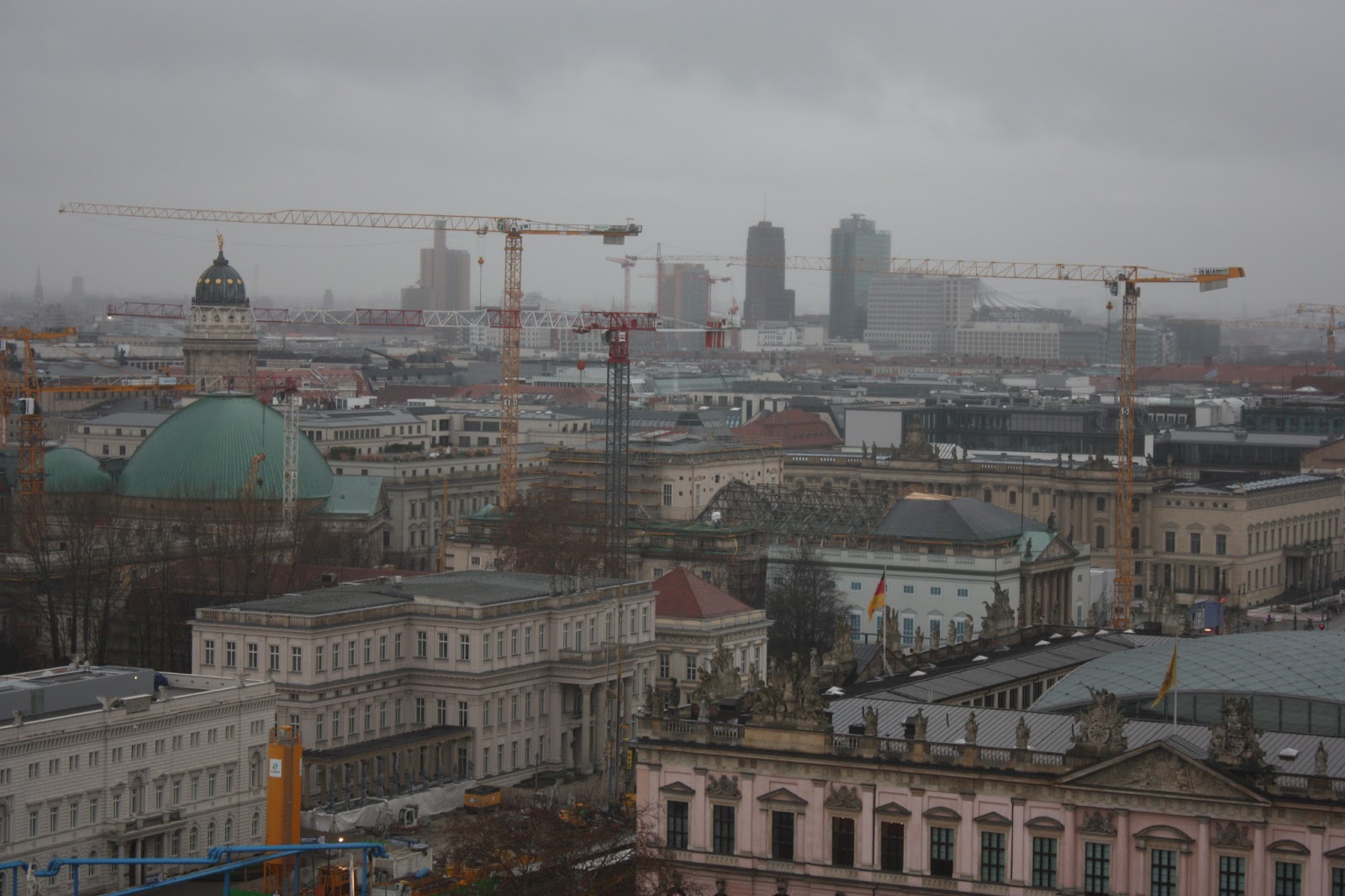
In many aspects, this gives the city a charm- a sense of life that sleepy Paris doesn’t have, because to me, Paris is in many ways, a city of the past that has someone managed to be transported into the present. But my feeling is that Berlin is unfinished. The number of cranes which dominated the skyline is surprising. 

 A skyline of cranes 

The view from the Berliner Dom 
 

There is so much history in Berlin – it was the site of many of the greatest confrontations and moments that were considered to define the twentieth century, but that meant that it has been drained and shattered – by two world wars, and under a brutal communist regime the marks of which continue to be visible today. I think Berlin may be more finished in ten or so years, and then, boy, I want to see it. 


The Reichstag - in itself an old building that was ruined by the NAZI party, which has been given a modern interior


Until then, my heart will be lodged firmly in Paris.  


I am in Paris, and very excited about this fact.

Sunday, 30 December 2012

The West is the Best! Adventures in Berlin


I am currently on holiday in Europe. The first leg of my journey is in Berlin.
My wanderings through the city have taken me into East and West Berlin (or the areas formerly known as East and West Berlin). I have come to the conclusion thus far that East Berlin is a place of grey sadness, and West Berlin retains its historical buildings, which makes it much prettier.

As we all hopefully know, Berlin as the capital of Germany was the headquarters for the NAZI regime, and then the site of what was arguably the greatest zone of confrontation between capitalism and communism during its occupation subsequent to the end of World War II. The reason (or one of the reasons) for this division was because the Allies and the Russians advanced upon the city in the final days of the war from different sides. The direction from which they came was not the only difference between the Allies and the Russians. The method used capture the city was very different. My trusty source of all military information (also my boyfriend) informs me that Soviets very methodically would take a city block by effectively razing it, and the moving on to repeat the process on the next block. Effective? Maybe. Destructive? Unquestionably. What this has meant was that the buildings that dominate the East Berlin landscape are typical of the communist era. The phrase that springs to mind to describe them is “the embodiment of an Orwellian Dystopia”. 

 The only tree in all of East Berlin. 


I actually turned off the black and white setting for this picture. That building in the background is the finance ministry (we hypothesised it may be a prison, initially). It has a mural of all the workers working together on its entrance.  


West Berlin has many trees


West Berlin is also just generally pretty

By no means do I wish to suggest that East Berlin has less value than West Berlin. However, I think that it is a great shame that the Soviets had control of that area of the city.

My advice for any travellers to Berlin: Stay in the Western part – there is great value in travelling during the days to the Eastern areas to see museums, monuments, and everything in between, but it’s much nicer to come home to a pretty neighbourhood when you’re away.

Tuesday, 18 December 2012

It's not how much you have, it's how you use it


Recently, there has been a spate of standardised testing conducted both locally and internationally. These tests reveal Australian students to be at a disappointingly low rank in the international community, particularly when it comes to literacy. It has been suggested that this is partly because many Australian students simply do not read enough. (This and this article explain the reports quite well).

Peter Garrett, the Schools Minister (whatever that title means), has pointed the finger of blame at a few factors, but one of them is inadequate funding. 


In life it is rarely how much you have but rather, how you use it. Undeniably, funds can mean that schools can acquire better facilities or learning tools, but having a library full of shiny new books is useless if nobody reads them.
There is an increasing trend in Australia society away from reading books to playing on ipads or computers. More and more, you can see mothers giving their children ipads or iphones to occupy them rather than a book or toy. This year, I tutored twin nine year old girls who each had an ipad, loaded with games. Unsurprisingly, they both did not read enough, or read books which were not beneficial to their literacy. 

When I ask my English students whether or not they read, I inevitably know the answer is going to be “not really”.
Increasing funding to schools isn’t going to help if the underlying culture and attitude toward reading remains unchanged. I know I certainly read less than I used to, and that’s partly because electronic distractions are so easily accessible.

When you set the pattern of reaching for an ipad rather than a book, that is a habit that will be set for life. No wonder the literacy of Australian students compares poorly to other societies.

It’s great that this is an issue which has been brought to our attention, but the answer from the Federal government should not be to throw money at it. That is a quick-fix solution that doesn’t do anything to change the culture that means that students don’t read enough.